Garage Door Opener Repair in Sikeston, MO
An opener that hums but won't lift, a door that bounces back before it closes, a remote gone dead: around Sikeston most opener faults trace to a short list of parts, and plenty can be repaired.
A worn-out unit gets swapped for one matched to your door and how often you use it. Some faults aren't in the opener at all, and a few take only a minute at home, so scan the checklist further down first.
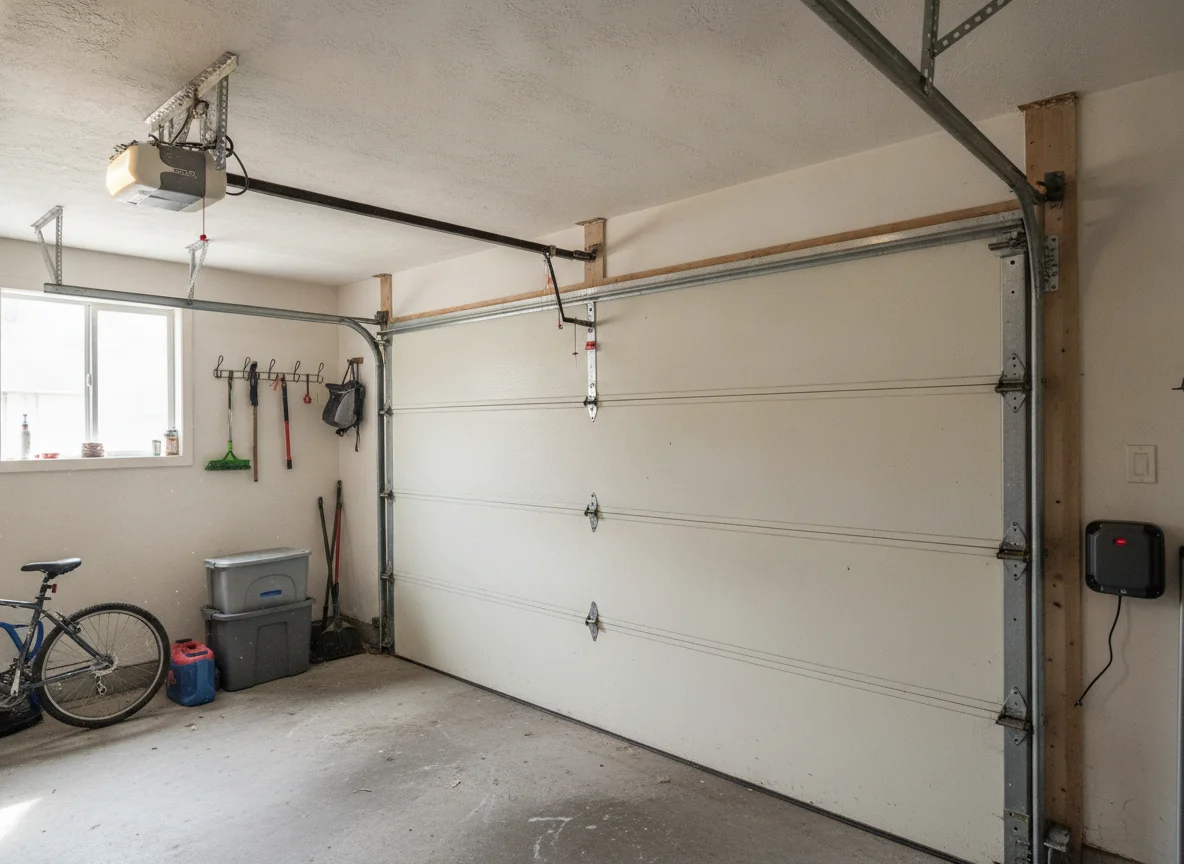
Symptoms and likely causes
Motor sounds off, yet the door won't move
Worn gear teeth, a dead start capacitor, or a door so heavy from a broken spring that the motor cannot lift it.
It closes a bit, then goes back up
Most often the photo-eye sensors: misaligned, grimy, loosely wired, or washed out by low sunlight. Now and then the down-force setting is off, or the door drags in its track.
Halts before the end
Limit settings have drifted, or the motor hits resistance it was never set to handle.
Remote or keypad gives no response
A dead battery, pairing lost in an outage (the May 26, 2024 tornado snapped power poles), or the lock button.
It has grown much noisier
A sagging chain, tired drive parts, or rollers binding in the track so the motor has to labor.
Completely dead, no response
A dead outlet, a breaker that tripped, or a logic board that gave out.
Motor spins while the door sits there, as the trolley has disengaged
The emergency release got tugged, or the carriage let go of it.
Humming, clicking or backing up? Describe what happens after you push the button.
Contact UsTry these before calling
A few apparent opener failures take seconds to solve, so look here before booking anyone to diagnose them:
Electricity
Does the opener's bulb come on? Plug a lamp into that outlet and look at the breaker panel.
Wall-panel lockout
A lot of wall panels carry a lock or vacation mode that shuts out every remote, and it gets pressed by mistake.
Fresh batteries for the remote and keypad.
Photo eyes
Two small eyes sit low on opposite sides of the door opening, each with a status light. A dark or flickering light means the beam is interrupted. Clean both lenses and bend them back into alignment until the lights burn steadily.
Low sun
A door that backs up only at certain hours is often being fooled by sun striking a lens; shading it, or swapping the two units' sides, may cure it.
When none of this works, or the motor hums while the door stays down, have a professional examine it.
Opener or door at fault?
Openers steer a balanced door; they weren't made to hoist its full weight. Once the springs give out, even a sound motor will strain, stall or turn around, and buying a new one cures nothing. Close the door and scan the spring shaft above the opening for a gap in the coil before blaming the motor.
Split coil? Read up on garage door spring repair.
Mend the opener, or swap it?
Fixing it tends to win if:
one component is to blame, say a gear, sprocket, capacitor, eye sensor, logic board or limit setting;
the maker still supplies its parts;
in every other respect it works smoothly and quietly enough.
Retiring it is the better move if:
it was built before auto-reverse became standard
Residential openers made from January 1, 1993 on fall under a U.S. Consumer Product Safety Commission reversing rule; a unit without that protection should go, whatever else is wrong;
replacement parts have been discontinued;
a repair would eat up most of what a fresh opener runs;
you're after features yours lacks, such as hushed operation, battery backup during outages, or phone control.
Picking a replacement
Chain-driven
Rugged and uncomplicated, though noisy. Fine for a garage detached from the house.
Belt-driven
Runs more quietly, which suits a garage with living space overhead or alongside.
Screw-driven
Simple build; ask about cold starts, since January lows average 27.3°F.
Jackshaft, wall-mounted
Attaches to the torsion shaft at the door's side, clearing the ceiling. Good for tall or odd ceilings, not every door.
Lifting power
A solid-wood, double-wide or thickly insulated door weighs more and calls for a stronger motor, balanced or not.
Optional extras to settle early
Backup battery, keypad, built-in camera or phone app.
When someone quotes a new opener, ask if it matches the door's weight and your ceiling height, and whether the sensors and wiring already in place stay or get replaced.
Say how the door behaves
Even a short description gets the ball rolling. You needn't know what the failed part is called.
What decides an opener repair bill
The failed component
An eye sensor or remote is a minor part; a gear or circuit board is not.
Brand, model and age of the unit, and whether the maker still stocks its parts.
Mending versus swapping
With a new opener: its drive style, lifting power and chosen add-ons.
Installation
A jackshaft unit, a tall ceiling, or no outlet close to the opener all mean extra labor.
Whether the door itself is in trouble
A motor battling tired rollers or a weakening spring keeps breaking down until the door is sorted.
Gather these first
The make and model printed on the label of the motor housing, a rough age, and exactly how it acts when you press the button: silent, humming, clicking, running partway, or running and then reversing.
Filming the door as you press the button tells a technician more than a long description.
Signs it's something else
Frequent questions
Can I pair a new remote on my own?
Often, yes. Most units have a learn button on the motor head, and the manual, or the maker's site once you enter the model, lists the button sequence.
Why would the door reverse just in the late afternoon?
Sun is shining into a sensor lens. Trade the two eyes' positions, or add a little hood over the receiving one.
Is it okay to pull the release and lift the door by hand?
Only with intact springs, and with the door fully down when you pull the cord. A balanced door lifts with little effort; a heavy one points at the springs first.
Will a new unit fit my existing door?
Nearly always, provided the door is balanced and travels freely. Mount one on a door that binds or hangs off balance and it burns out before its time.
More garage door work
Garage Door Spring Repair
Failed torsion or extension springs replaced with ones rated for the door's weight.
Read more →Garage Door Off Track Repair
Doors back in their tracks, bent rail straightened and rollers that have worn out replaced.
Read more →Garage Door Maintenance
An inspection covering springs, cables, rollers and auto-reverse before any of them fails.
Read more →Send the details
If you can read the label on the motor, send the brand and model. Add what happens when you push the button and whether you can raise the door by hand; that normally shows whether it is a sensor, a gear or a whole new unit.